Hazardous Waste Storage Requirements
Satellite Accumulation Areas
Most hazardous waste containers generated at the U of M are stored in satellite accumulation areas (SAA). Not only do SAAs provide a safe and effective means to accumulate hazardous waste before removal by HSRM, it also is the least restrictive regulatory option. The following hazardous waste storage requirements must be followed:
- All waste must be stored in containers. Usually the original container of the main component of the waste can be used (i.e., 4-liter glass jar). Reusable containers such as 20-liter carboys can also be used to collect waste.
- Containers must be compatible with the waste they contain. For example, do not use metal containers for corrosive waste or glass containers for waste containing hydrofluoric acid. For liquid waste, only use a container designed for liquids; the container must seal and not leak (no liquids in bags). Food grade containers such as milk jugs should never be used for chemical storage.
- Containers must remain closed at all times except when adding or removing waste. Open waste containers is the most common hazardous waste violation cited at colleges and universities. Not only is this a violation, it is also unsafe.
Containers must be labeled with the following information:

Properly labeled waste containers. - The words "Hazardous Waste"
- Description of the waste (i.e., Chloroform 80%, Water 20%)
- Description of the primary hazard present (i.e., Flammable)
- Date waste was first added to the container (start date)
- All liquid waste must be stored in secondary containment such as trays or buckets.
- All containers must be in good condition and not leaking.
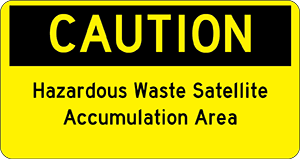
- Containers must be stored at or near the point of generation and under the control of the generator of the waste. Waste must remain in the same room that it is generated in. Establish an area to accumulate hazardous waste. This area can be a bench top, fume hood that is being used for storage, or a cabinet. Identification of SAAs by signage is recommended. Do not place containers in areas such as hallways, sinks, or next to moving equipment where the chance of spills is likely.
- The waste storage volume should never exceed 55 gallons per SAA.
- Containers must be segregated by chemical compatibility during storage. For example, acids should be stored away from bases. Segregation can be achieved by either physical distance or secondary containment. Avoid mixing waste streams such as acids and bases, or aqueous and organic solvents in the same waste container. Collect all highly toxic, reactive, mercury, and any exotic wastes (i.e., dioxin compounds, PCBs, controlled substances, pesticides) separately.
Hazardous Waste Disposal
To have waste removed from a SAA, follow the hazardous waste disposal procedures detailed on the DEHS Regulated Waste web page.