According to OSHA, “contaminated sharps” means any contaminated object that can penetrate skin including, but not limited to, needles, scalpels, razor blades, broken glass, broken capillary tubes, and exposed ends of dental wires [29 CFR 1910.1030(b)]. It is important to follow best practices for sharp safety to avoid inadvertent injection of any of the possible hazardous materials in the laboratory. Possibilities include mishandling a sharp-edged piece of a contaminated broken glass beaker or misuse of a sharp object, such as a knife or hypodermic needle.
Selection, Recognition and Protection

- Only use sharps when absolutely necessary. If possible, use safety engineered sharps (Luer locking syringes)
- Recapping needles should be avoided whenever possible.
- If recapping is necessary, it must be written into your SOPs and accomplished through an approved recapping method. Follow the Biosafety guidelines for use of sharps, an explanation of re-sheathing needles, recapping devices and the one hand method (Figure 1).
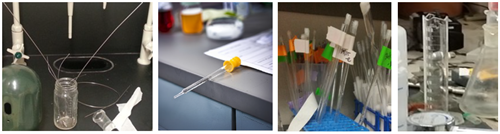
- Besides disposable needles and razor blades, reusable needles and glassware are often overlooked as potential sharp injuries. Glass that is often easily broken, damaged and sources of broken glass include: the bottom of a sink, NMR tubes, pipettes, capillary tubes, graduated cylinders, glass dewars, disconnecting Schlenk lines and rotovaps (Figure 2). Remember cracked or damaged glass is often hard to detect, especially in soapy water, so handle all glassware as if broken.
- Use protection to guard against possible cuts. Cut-resistant gloves should be worn underneath over-sized nitrile gloves. Electrical tape or plastic mesh can be wrapped around glassware to help contain it if it breaks. Place plastic mats on sink bottoms to cushion glassware. Place broken glassware containers inside trays to protect the cardboard from moisture. Store re-usable needles and syringes inside hard sided containers. Use a hard sided NMR tube carrier to prevent breakage during transport.
- Use tongs or tweezers and a brush and dustpan to handle broken glass. Do not use hands to pick up broken glass. Use a wet paper towel to wipe up small fragments.
Use Extreme Caution when Handling Sharps
- Always point sharps away from you and other people. Cut away from your body.
- When in use, keep sharps where they are clearly visible and facing away from the edge of the counter.
- Pay close attention. If possible, secure the container you are drawing from with something other than your hands.
- Needles must not be bent, sheared, broken, recapped, removed from disposable syringes, or otherwise manipulated before disposal

Disposal and Storage:
- When finished with your procedure, discard the sharps into the appropriate container.
- Reusable syringes and cannulas should be promptly cleaned then stored in a hard-sided container.
- Broken glass boxes (Figure 3) should be closed when < 90% full and taped.
- Broken glass should be stored in an appropriate puncture and leakproof container that is clearly labeled as ‘broken glass’ and closed before disposal.
- Use smaller broken glass boxes whenever possible. If broken glass boxes exceed 50 pounds, they will not be picked up by custodians.
- Cardboard containers are required to be 2-ply and contain a plastic liner.
All uncapped syringes and blades must be placed in sharps container (Figure 4), even if they are not infectious. Sharps containers must be closable, puncture-resistant, properly labeled, accessible, maintained upright and leak-proof on sides and bottom. Do not use soft-sided plastic jars or similar containers.

Figure 4: Only use hard sided shapers containers. Never use soft sided containers or mix with other lab waste. - Never fill a sharps container more than ¾ full. Sharps containers must be kept inside the lab and never left in public areas.
- Sharps contaminated with trace carcinogens or hazardous drugs must be disposed of in a separate sharps container that is labeled “Chemo Sharps,” sealed, and placed in a yellow bag for incineration.
- Sharps contaminated with other hazardous chemicals should be treated as hazardous waste.
- Do not put other lab waste (e.g., gloves, Kimwipes, weight boats, etc.) in sharps or broken glass containers (Figure 4).
If you do get Injured or Cut:
- Encourage the (minor) wound to bleed and wash with soap and water for 15 minutes.
- Apply pressure and seek medical attention. This medical evaluation will be covered by worker’s compensation and not your typical insurance. Blood may be taken to screen if prophylactic treatment is needed depending upon what you were exposed to.
- Report the injury promptly to your supervisor. OSHA’s Bloodborne pathogen standard requires that all sharps injuries are reported, even if they do not seem serious. A first report of injury (FROI) must be completed.
- If your work involves an IBC protocol, you must also report the incident to the IBC.