Some student groups will coordinate outreach events, that is, bringing the public to your work area or your work to the public. Common outreach events include elementary school visits, State Fair science booths, etc. When taking your science on the road, you must consider not only your own safety, but the safety of your audience. It is good practice to perform a risk assessment of the experiments you are considering taking to off-campus locations. If the chance of something going wrong is increased due to lack of laboratory controls, is it worth the risk and the potential of putting your audience in harm’s way (along with the negative publicity)? Remember to coordinate with the site manager. Provide details regarding the experiments to be performed, chemicals to be used, or other relevant information. Some locations may not allow the use of hazardous chemicals or equipment.
When preparing for an outreach event, ask each other the following:
- How is appropriate PPE selected?
- If PPE is to be shared, how is it cleaned between users?
- Is PPE required when working with household materials and equipment, specifically for hands-on activities?
- How are chemicals and supplies safely transported to the outreach site?
- Why are used chemicals and supplies not disposed of at the outreach site?
- Is it safe to send children home with science souvenirs?
- Are there any hazards that require the activity to be a minimum distance from the audience?
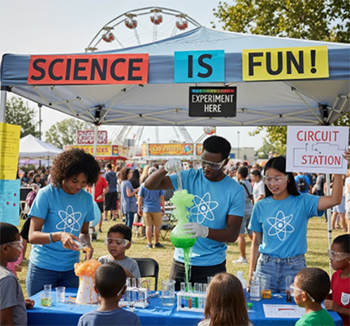
Remember that the audience at an outreach event is often elementary-aged children and the excitement level may be high. Children are fascinated with colorful chemicals, fire, and food-based experiments. It is important that boundaries are set to keep the audience a safe distance from any potential hazards. This is particularly important when cryogens, flammables, hot surfaces, or spills and splashes are possible. If presenting food-based activities, be aware of potential food allergies. The American Chemical Society has excellent resources on Safer Experiments and Demonstrations.
Public Events on Campus
If a student group is to hold a public event on University property or within a University owned building, the Building Codes Department (BCD) will be required to review the proposed event. Activities that may require permits and inspections from BCD include:
- Serving food (submit a Food Permit Form prior to the event)
- Setting up a tent
- Adding a stage, platform, or bleachers may require a building permit
- Providing heat or electricity to a space or cooking food may require a mechanical and/or electrical permit
- Hosting inside a building not designated for public assembly may require a building permit
Contact the Building Code Department (BCD) with any questions 612-625-3318 or [email protected]. More information can also be found on the Event Planning page of the Student Unions and Activities website.
Traveling to Remote Locations
Some student groups will occasionally travel to ‘remote’ locations, ranging from short treks to Coffman Union all the way to continent-wide electric vehicle races in Australia. For groups that travel off-campus and away from populated areas, a Field Safety Plan must be developed. This plan will address topics including:
- Traveling to and from the remote site
- Review requirements for renting a vehicle from University Fleet Services
- Methods of communication between group members, emergency services, etc.
- Is there cellular service at your remote location?
- Will satellite phones be required?
- If on a body of water, are members trained on the use of marine radios?
- Responding to injuries and illnesses
- First aid, CPR, and/or AED training
- How far away is the emergency response?
- Required equipment is to be reviewed and outlined in your Field Safety Plan, including:
- First aid kits
- Camping equipment
- Flashlights
- PPE
- Maps and directions
- PPE
- Responding to sudden changes in weather conditions
- Exposure to sun, heat, and cold
Additional information on developing a Field Safety Plan can be found in the HSRM document library.