The safety equipment required for your space will be determined by the type of work performed and the associated hazards.
Fire Extinguishers

At a minimum, your work area should have an accessible and up-to-date ABC Dry Chemical fire extinguisher, located near the exit(s). ABC extinguishers are the most common type of extinguisher found on campus. If your work involves the use of flammable metals, including certain lithium-based batteries, a Class D extinguisher should be considered. Performing a risk assessment of your work will help determine the class and number of extinguishers needed.
First Aid Kits
Student group work areas may present physical hazards that can result in injuries including minor cuts, abrasions, and burns. It is strongly recommended that a modest first aid kit be kept in an accessible location within the workspace. First aid kits can be purchased through UMarket.
Emergency Eyewash and Shower Stations
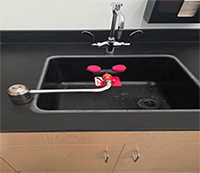
If your work involves the use of corrosive chemicals or large quantities of flammable liquids, an eyewash station, and potentially an emergency shower, is required in the work area. Eyewash stations are used to flush your eyes and face with water in the event of a small chemical splash. Showers are used in the event of a large chemical splash or fire. If your work area is not equipped with this equipment, please consult with your faculty advisor or your HSRM safety partner.
Personal Protective Equipment
When working with potentially hazardous chemicals, biologicals, or physical processes, a hazard assessment must be performed to determine the type of personal protective equipment (PPE) required. Examples of hazards and the required PPE are displayed in the table below:
| Hazards | Examples | Required PPE |
|---|---|---|
| Impact | High-velocity particles, chips, or high-pressure liquids | Impact-rated safety glasses or goggles, face shields, hardhats |
| Puncture | Working with glass, wire, sharp objects or materials that can pierce when broken | Cut-resistant gloves and sleeves |
| Compression | Working with heavy equipment or objects that can pinch or crush | Steel-toed boots, gloves |
| Thermal | Furnaces, cryogens, welding, steam | Thermal gloves, flammable-resistant clothing |
| Chemical | Corrosives, toxics, poisons | Gloves, glasses/goggles, lab coat |
| Optical radiation | Lasers, UV lamps, welding arcs | Laser eyewear, UV-rated face shield, welding mask |
| Biological | Micro-organisms capable of causing disease | Gloves, glasses/goggles, lab coat |
| Dust/particulates | Welding fumes, silica dusts | Respirator, gloves, glasses |
| Noise | Machinery, engines | Ear plugs and/or muffs |
Before using any form of PPE for the first time, your faculty advisor or senior group member should train you on proper selection, donning (putting on) and doffing (removing), storage, inspection, and cleaning.
Respiratory Protection

If it is determined from your hazard analysis that a respirator (N95, half or full-face mask) may be required for your work, please contact Biological and Occupational Health Department (BOHD) to arrange for a consultation. For more information, see the Respiratory Protection Program.