Safety Training
Students working with hazardous materials or equipment may be required to complete safety training relevant to these hazards. Below is a table of some of the training offered by HSRM. Contact your HSRM safety partner to determine which training modules are required or recommended.
| Activities | Training Requirements |
|---|---|
| All hazardous work | In-person work-specific training |
| Work with chemicals | Safety in the Research Lab |
| Biological | Biological Safety in the Laboratory |
| Flammables | Fire Extinguisher Selection and Use |
| Lasers | General Laser Safety |
| Work around chemicals | Hazard Communication |
| Field work, shop work | Cold Stress |
| Electrical | |
| Chain saws | Chain Saw Training |
| Forklifts, etc. | PIT training |
From the training listed above, in-person task-specific training is the most crucial. This training is to be given by the faculty advisor or a senior group member and will detail the hazards associated with the work performed and how to mitigate these hazards through various controls. It is required annually and when new members join the group (usually at the start of the school year). Staff from HSRM will also be happy to give general safety presentations to your group.
Safety Documentation
It is important to maintain documentation related to hazards present in your work area and the safety controls that have been implemented. Safety documentation may include:
- A Safety Manual will detail the general hazards of the work area, policies and procedures required when performing tasks in the work area, and information on responding to incidents and emergencies (fire, injury, severe weather, etc..)
- If working with, or around, hazardous chemicals, Safety Data Sheets (SDS) are to be made available to all group members. An SDS is a written document provided by the chemical manufacturer and is used to communicate chemical hazards in greater detail than information found on a label. This information is used to develop safe storage and handling procedures, disposal procedures, and emergency response.
- Standard Operating Procedures (SOPs) are step-by-step instructions on carrying out various tasks. These documents will not only lay out instructions but will detail any potential hazards associated with the work and methods to mitigate these hazards. SOPs are especially important when working with high-hazard chemicals, biologicals, or physical processes.
- Training Documents, such as work-specific training or Training Hub reports, should be kept by the Faculty Advisor.
Additional Safety Requirements
Chemical and Biological Storage
Hazardous chemicals and biological materials must be kept in appropriate storage, as specified by a Safety Data Sheet, SOP, or the UMN Chemical Hygiene Plan. The type and design of storage will depend on the hazard of the chemical or biological material:

Flammable chemicals should be stored in a vented flammables cabinet or a flammable-rated refrigerator. These are specifically engineered to keep your flammable chemicals safe from a fire.
- NEVER store flammable chemicals in a standard refrigerator. Flammable vapors may accumulate in the compartment and could ignite if exposed to an ignition source, such as the light bulb or thermostat.
- Corrosive chemicals (acids and bases) should be stored in corrosion-resistant cabinets, ideally with ventilation (e.g. under a fume hood). Storing corrosives in standard cabinets may result in damage to the interior hardware, such as hinges and shelf supports.
- Biological materials should be kept in refrigerators or freezers (-20 °C or -80 °C) until ready for use. Make sure only samples are stored in these units and never food or drink. Label the exterior with a ‘Biohazard’ sticker.
- Chemicals, other than cleaners and bleach, are not to be stored in the cabinet below a sink.
- NEVER keep food or drink in a chemical refrigerator. Label the refrigerator as ‘No Food or Drink’.
Hazardous Waste Disposal
If your work generates any type of hazardous waste (solvents, corrosives, oils, biological or radioactive materials), it must be collected, stored, and disposed of properly. Never throw away hazardous materials or pour chemicals down the drain.
- Chemical waste must be placed in an appropriate container and kept closed at all times except when adding or removing waste. Liquid waste containers must be stored in secondary containment (e.g., tub, tray, bucket).
- Food-grade containers (milk jugs, sauce jars, etc..) are not to be used to store chemicals (waste or otherwise).
- Chemical waste containers must be labeled with the words “Hazardous Waste,” an accurate description of the waste, the primary hazard(s) associated with the waste, and a start date. Any constituent in concentration of less than 1% must be listed as "trace" quantity. Non-regulated constituents in high concentration such as water must also be included in the description (i.e., Water 50%, Acetonitrile 40%, Methanol 10%, Acetic Acid trace, Formic Acid trace). Waste labels are available, free of charge, from HSRM.
- Submit waste using Chematix, which is the University of Minnesota’s online chemical waste pickup system. Visit the CHEMATIX homepage and click the “Waste” tab for detailed submission instructions.
If you have an unknown chemical in your area, complete this online form. Once submitted, HSRM will come to your location to pick up the unknown chemical and properly identify it.
Hygiene and Housekeeping

Following proper hygiene practices is important when working in areas with hazardous materials as they will help prevent exposure to harmful chemicals or biological materials. When working in these areas, be sure to observe the following:
- Food and drink are NOT allowed in workspaces in which chemical, biological, or radioactive materials are stored or used.
- Long pants/skirts and closed toe/heel shoes are required in these areas.
- Synthetic clothing should be avoided if working around flammables.
- If you work around rotating machinery, tie back or confine all long hair, loose clothing, and jewelry.
- Wash hands after machining or working with chemical or biological materials and before leaving the work area.
Housekeeping is an important part of safety, no matter what work is being performed. Clutter can lead to accidents, cause spills, or help fires spread faster. Some important aspects of good housekeeping include:
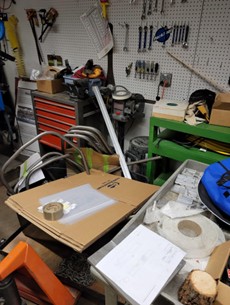
Keep aisles, exits, and hallways clear. There should always be a clear pathway to get out of the area. Do not use hallways or aisles as storage areas.
- Do not block safety equipment and exits. Be especially cautious about storing bikes, scooters, skateboards, and other transportation gear – these are often left by exits, blocking your way, and can cause slip hazards from water or dirt.
- Remove all slip or trip hazards when you identify them. This could include water or oil leaks/spills, extension cords, rugs, storage boxes, and other items.
- Keep all drawers and cabinets shut when not in use. You could potentially trip over an open drawer or be struck by an open cabinet door.
- Make sure shelves are properly supported and are not overloaded with weight. Too many books, chemical containers, or other equipment can make shelves bow in or break. Cabinets and shelves should be secured to the wall to prevent tipping.