Laser Safety in Classrooms and Educational Labs
Lasers, ranging from pointers to research-grade systems, may be found in educational settings, such as lecture halls and teaching labs. Special considerations must be taken into account when using lasers in settings where potentially large audiences may not be afforded the same personal protection normally found in a research lab. Resources for the safe use of lasers in educational settings are available using the links to the right.
Lasers used for lecture hall or classroom demonstrations
When setting up a laser for a classroom demonstration, care must be taken to protect both the laser user (instructor) and the students in the audience.
- Class 3B and Class 4 lasers are prohibited in lecture halls and classrooms. Use Class 1 or Class 2 lasers whenever possible. Class 3R lasers are to be used only when absolutely necessary and are handled with caution.
- When setting up the demonstration, verify the beam path to ensure it will not encounter any reflective surfaces not part of the demonstration. Trace the beam path to confirm no portion of the beam is directed toward students, doorways, or windows.
- If the laser demonstration is set up by someone other than the instructor, the instructor is to receive safety and operating instructions prior to the lecture.
- The instructor is to verbally warn the class that a laser is about to be activated.
- Activate the laser only when ready to perform the demonstration. Switch the laser off immediately at the conclusion of the experiment.
- Unplug the laser or remove the activation key at the conclusion of the experiment. This will prevent students switching on a potentially unsupervised laser after the lecture is over.
Setting up lasers in teaching labs
The risk of inadvertent exposure to laser light is increased in teaching labs as students may be expected to work closely with the laser setup. In some situations, there may be multiple experimental setups resulting in several lasers activated at the same time. In addition, students, particularly undergraduates, have most likely not received prior laser safety training. It is important (and required) that the instructor or teaching assistant is trained on laser safety and can clearly explain to the students, before the students have access to a laser, how to use the laser system(s) properly.
- If multiple lasers are required to be set up in the same teaching lab room, ensure that all beams are directed away from other student workstations or interrupted by barriers or beam blocks.
- Whenever possible, only use Class 1, Class 2, or Class 3R lasers.
- Note: Class 3R lasers are capable of causing permanent damage to the eye if it is exposed for an extended period.
- Unless a particular experiment requires the use of an invisible beam, visible lasers should be exclusively used.
- If a Class 3B laser is required for an experiment, additional safety controls must be implemented, including
- Appropriate PPE
- Signage and window coverings
- Additional training
- Class 4 lasers should rarely be used and only when the beam is completely enclosed and there is no possibility of accidental exposure.
Any use of a Class 3B or Class 4 laser in a teaching lab must first be approved by the LSO.
The use of laser pointers in a classroom or lecture hall
Laser pointers are frequently used in classrooms to emphasize information contained in projected computer lecture presentations. Care must be taken that the laser is never pointed toward the class to prevent potential harmful exposures. Some guidelines to follow if using a laser pointer include:
- Permissible Classes: Only Class 1 or Class 2 laser pointers are generally permitted. Class 3R laser pointers are discouraged. Class 3B and 4 pointers are strictly prohibited.
- It is strongly recommended that Class 1 or Class 2 pointers with a wavelength of around 650 nm (red in color) are exclusively used.
- Prohibited Actions: Never aim the pointer directly at a person's eyes, cameras/projectors, or doors and windows.
- Handling and Storage: Turn off and store the laser pointer when not actively presenting. Only use laser pointers with momentary power switches (that is, the laser turns off when your thumb leaves the switch).
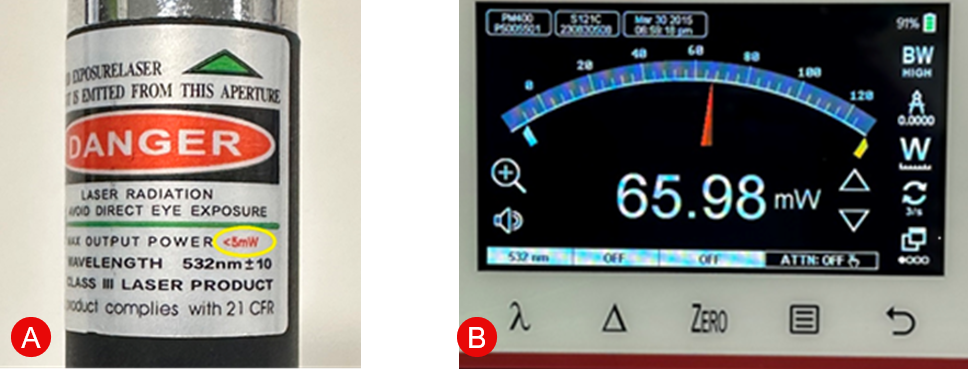
- Verify output power: If you purchase a laser pointer to be used in lecture, contact the Laser Safety Officer and verify the output of the laser matches the power indicated on the manufacturer’s label.
Lasers on campus have been found to output significantly more power than the label indicated. Exposure to such beams would result in permanent damage to the eye.
Requirements for the use of Class 3B or Class 4 lasers
If using Class 3B or Class 4 lasers in a teaching environment, those responsible for setting up and/or using the systems are required to:
- Review the University Laser Safety Written Program and Lasers in Education Guidance Document
- Complete laser safety training (both online and in-person lab-specific)
- Register their laser(s) or laser system(s) with the Laser Safety Officer
- Be provided with and use appropriate PPE (minimally laser eyewear)
- Develop Standard Operating Procedures (SOPs) for the alignment of laser optics and the general use of lasers
- Develop procedures and controls to prevent members of the class from inadvertent exposure to harmful levels of laser radiation
The items listed above will satisfy many requirements found within ANSI Z136.1 - Safe Use of Lasers (2022) and ANSI Z136.5 - The Safe Use of Lasers in Educational Institutions (2020).
Accidental exposure to laser light
In any setting, if a student reports a suspected exposure (flash blindness, pain, or an afterimage), secure the laser and report the incident to the Laser Safety Officer immediately. Advise the student on how to seek medical attention.